
BIM Quality Assurance
Trust your models
Data checked, issues flagged, risk avoided
A comprehensive, standardized quality check of your IFC models against industry best practices and project-specific requirements. Delivered with detailed reporting and expert consultation to ensure your BIM models meet professional standards and project goals.
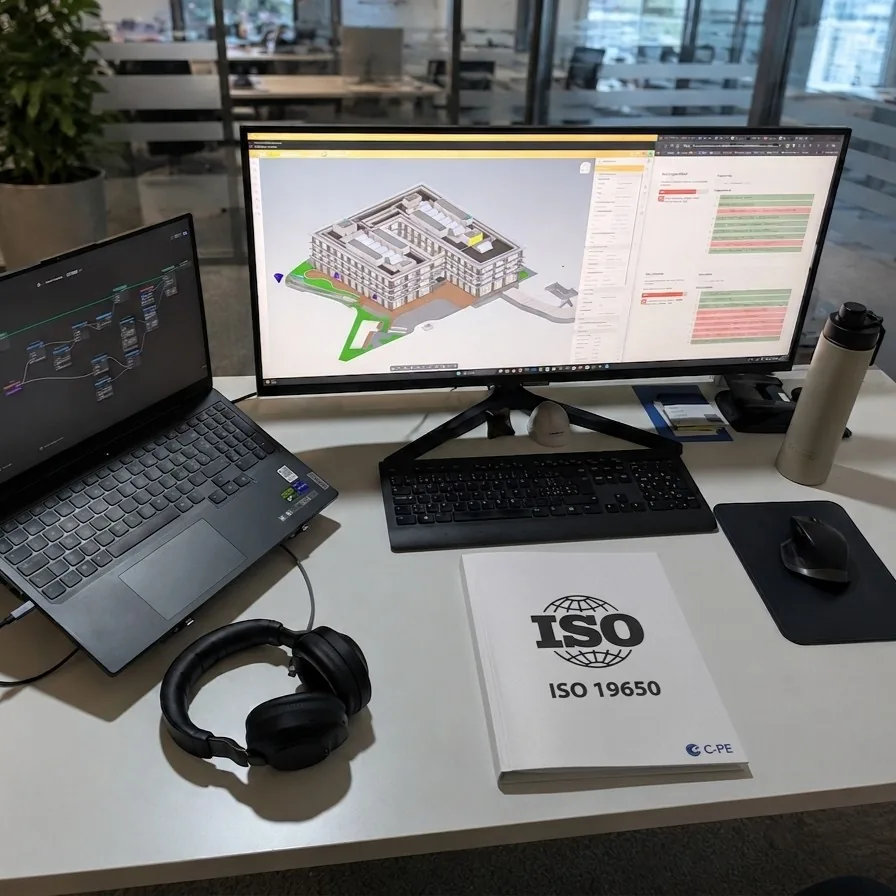
Are you sure that your models follow every requirement and standard?
Common problems met
- Non respect of IFC standards: Poor IFC structure, classification, or spatial hierarchy blocks data use in downstream applications.
- Guidelines not followed: Design teams struggle to apply all BEP/EIR rules, leading to inconsistent and non-compliant models.
- Required data is missing: Critical information is frequently absent or incorrectly formatted in model objects.
- Files not checked before submission: Checking your own models before submissions requires time and dedicated tools that you lack.
A comprehensive quality check can clear that out for you
BIM Something approach
Objective, automated validation is provided, immediately converting project compliance risk into verifiable certainty.
- IFC Structure Validation: Deep, automated checks are performed on IFC schema, spatial structure, and classification to guarantee models are technically sound and fully usable by all downstream software.
- Requirements Implementation: Complex BEP/EIR documents are converted into clear, quantifiable validation rules, providing objective proof that every project requirement is consistently met across all models.
- IDS Information Check: Every object is audited to ensure all required attributes and properties are present, correctly formatted, and assigned, delivering a complete, handover-ready asset model.
- Proactive Quality Assurance: Fast, repeatable, and comprehensive model checking is delivered to catch critical non-compliance issues before submission, protecting deadlines and minimizing costly rework.
- Team Coaching: Expert consultation and review meetings with the project team to ensure that mistakes are not repeated.
Model checking tiers
Choose the right level of support with three scalable packages, ensuring you get precisely the IFC quality assurance your project demands.
Tier 1- Essential -
Tier 2- Comprehensive -
Tier 3- Full Information Check -
Scope
Scope
Scope
- Scope adaptable for any project size
- Essential proprietary criteria list
- Compliance verification against OpenBIM best practices
- Everything from Tier 1
- Comprehensive proprietary criteria list
- Project specific compliance against BEP and EIR requirements
- Everything from Tier 2
- Creation of a custom project specific IDS file for information checking
Deliverables
Deliverables
Deliverables
- Detailed PDF report, including expected results, found issues, illustrations and comments
- CSV data lists
- 45min review meeting with project team
- Everything from Tier 1
- BCF issues sharing, with 3D mark-ups
- 60min review meeting with project team
- Same as Tier 2
- IDS report in PDF and HTML formats
- 90min review meeting with project team
Delivery Time
Delivery Time
Delivery Time
- Within 5 working days
- Review meeting 1 week after report delivery
- Within 10 working days
- Review meeting 1 week after report delivery
- Within 10 working days
- Review meeting 1 week after report delivery
Tiers Comparison
| Essential | Comprehensive | Full Information Check | |
|---|---|---|---|
| Scope | |||
| Core Quality Check | |||
| Project Specific Compliance | |||
| Deliverables | |||
| Detailed PDF report | |||
| CSV Data List | |||
| BCF Issues | |||
| IDS Report | |||
| Review Meeting | 45min | 60min | 90min |
| Timeline | |||
| Within 5 working days | Within 10 working days | Within 10 working days | |
| Options | |||
| Express Delivery | Subject to availability | ||
| Unlimited follow up checks | Until models full validation |
Frequently asked questions
What is the difference between quality assurance and quality control?
Quality assurance refers to the processes put in place upstream to prevent errors, while quality control refers to checking the deliverables to detect errors already present. Quality assurance is preventive: it defines the procedures, export templates and modeling rules that make it possible to produce correct data. Quality control is corrective: it consists of auditing the IFC models against the information requirements before each milestone. The two are complementary: good procedures reduce defects, but a check remains necessary to verify what was actually delivered.
What is an IDS?
An IDS (Information Delivery Specification) is a standard buildingSMART format for defining a project's information requirements in a machine-readable way. It makes automated checking of an IFC file possible: you verify that the expected elements are present, correctly classified and carry the required properties. IDS is the technical layer that makes information requirements (LOIN) genuinely verifiable, rather than intentions written in a specification document. Its adoption is still recent on the Swiss market, but it is becoming the reference for information checking.
What does a BIM quality check cover?
A BIM quality check verifies that a model complies with the project's information requirements, beyond its geometric appearance alone. I check several levels: the structure of the IFC file (spatial hierarchy, element classification), the presence and accuracy of the expected properties, the consistency between disciplines, and the soundness of the export process. As far as possible I use IDS-based checks, to make the control objective and repeatable. The goal is not to judge the quality of the teams' work, but to confirm that the delivered data corresponds to what was requested and will be usable at handover.
Next step?
Book a call to discuss your project and receive a definitive offer.
No obligation or engagement.